

Showing posts with label AC Simulator. Show all posts
Showing posts with label AC Simulator. Show all posts
Jan 6, 2021
AC Simulator - KNOWLEDGE REQUIRED BY LOCO PILOT ( एक अच्छे लोको पायलट की गुणवत्ता )
KNOWLEDGE REQUIRED BY LOCO PILOT FOR DRIVING TECHNIQUE
"All Loco Pilots should have Sound road knowledge & Self-confidence to operate / handle loco & train."
1. Knowledge of driving rules.
2. Knowledge of train management.
3. Knowledge of brake management.
4. Reduce brake wear & tear.
5. Reduce damage of couplets.
6. Use less energy.


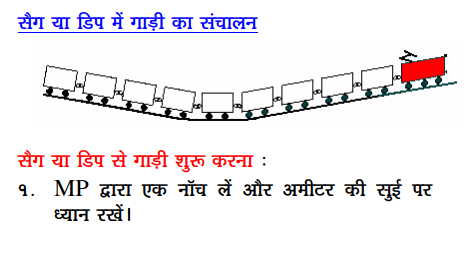
AC Simulator - TRAIN HANDLING IN SAG OR DIP GRADIENT (सैग या डिप में गाडी का संचालन )
TRAIN HANDLING IN SAG OR DIP GRADIENT
Starting of train from sag or dip gradient
i) Advance MP to notch 1 st and note the increase of current on the ammeter.
ii) Release SA-9 (loco brakes) and wait for the release of the locomotive brakes.
iii) After a few second pause advance the MP and again note the ammeter indication. If necessary advance the MP to position 3 rd or 4 th notch.
iv) If acceleration is too rapid, reduce notches 1 or more. When the complete train is in a stretched condition & in motion, slowly advance the MP as required.
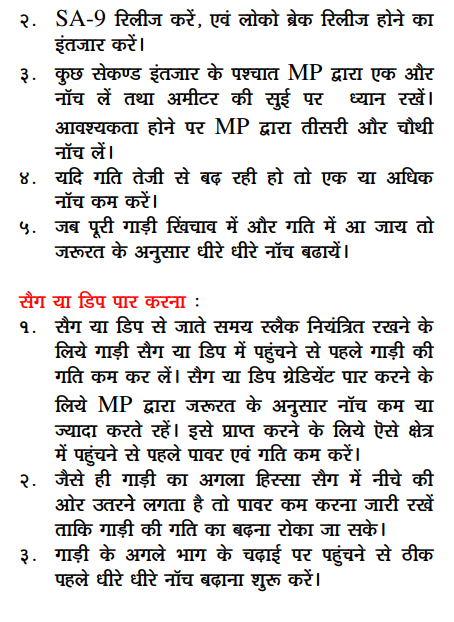
Negotiating sag or dip gradient
i) In order to control slack when moving through a sag or dip, the train speed must be allowed to reduced before the train moves into the sag or Zonal Railway Training Institute, Central Railway, Bhusawal ©AC Loco Simulator. dip & MP manipulation used to negotiate the sag or dip gradient. This can be achieved by reducing power & speed before reaching such areas.
ii) Continue to reduce power to prevent speed increase as the head portion of the train begins descending in to the sag.
iii) Just before the leading portion of the train reaches the ascending grade, begin to advance notches gradually.
iv) Continue to advance the MP on one notch at a time until the rear portion of the train approaches the base of the sag or dip.
v) Reduce power as the rear portion of the train starts on the ascending grade of the sag or dip thereby permitting slack to adjust gradually.
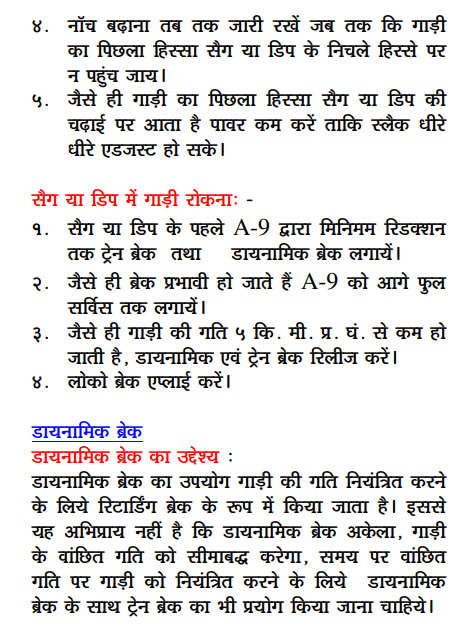
Stopping the train in sag or dip
i) In advance of the sag or dip, apply A-9 brakes to minimum reduction & engage dynamic brakes.
ii) As the brakes gets effective apply A-9 further up to full service.
iii) As the speed decrease below 5 KMPH release dynamic brakes as well as A-9.
iv) Apply SA-9.
AC Simulator - TRAIN HANDLING IN HUMP (KNOLL) & CRESTING GRADIENT (हम्प (नॉल) और शिखर वाले ग्रेडीयेंट पर गाड़ी का संचालन )
TRAIN HANDLING IN HUMP (KNOLL) & CRESTING GRADIENT
Starting of train on a hump or cresting grade There are no special requirements for starting on a hump or cresting grade. The starting procedure are the same as for starting the train on an ascending (up) grade. Zonal Railway Training Institute, Central Railway, Bhusawal ©AC Loco Simulator.
Negotiating Hump(knoll) gradient
i) Approach the hump with reduced power thus providing margin for power increase and for stretching the train as the locomotive starts up the hump. Increase power, if possible, to avoid bunching the slack at the leading end and maintain this stretch condition until the locomotive reaches the crest of the hump.
ii) As the locomotive passes the hump, and starts to pickup the speed the drawgear will tend to stretch out. To keep slack action to a minimum, reduce power to keep speed constant.
iii) Keep the slack action to a minimum by MP manipulation to suit loading on the train and the grade condition.
Negotiating crest grade
i) Changing of slack condition - the train slack is required to change from a stretch condition while ascending or approaching the crest to a bunch condition on the descending portion.
ii) Road knowledge - The Loco Pilot must be aware of the characteristics of terrain for adequate braking on the descending grade following the summit. Zonal Railway Training Institute, Central Railway, Bhusawal ©AC Loco Simulator.
iii) Maintain constant speed - as locomotive reaches the crest of grade, the Loco Pilot should attempt to maintain speed by reducing MP to relieve stress on couplers at the crest.
iv) Use of dynamic brake after a crest - A following down grade is long steep, the dynamic brake should be engaged after one half of the train has crested over the summit, the dynamic brakes should be engaged and carefully adjusted to control speed & gradually bunched the train.
v) Balancing a cresting grade - If the grade following the summit is a light descending grade, MP manipulation & dynamic brake may be used to control speed and train slack movement. If dynamic brake is not available, the train brake should be used in the same manner as for the descent of a light descending grade.
Stopping of train on a crest grade
i) Avoid drawgear stresses :- Take all efforts to avoid stopping of train on a cresting grade, for which the Loco Pilot must have a good knowledge of the location of all cresting grade. A stop of a train on a cresting grade can Zonal Railway Training Institute, Central Railway, Bhusawal ©AC Loco Simulator. 80 lead to excessive drawgear stress on the wagon at the crest while attempting to restart the train.
ii) Reducing drawgear stresses:- If a stop has to accomplish, do so in accordance with the stopping procedures for descending grades. When stopping on a cresting grade, always ensure that the brake application used to stop the train is the lightest possible thereby reducing drawgear forces particularly on the apex of the crest.
Stopping on a hump or knoll grade
Avoid Run-ins: -While stopping the train on a hump, extreme care must be taken that the brake application does not result in severe run-in. To avoid slack bunching on the hump or knoll, the train should be stopped in a stretched condition.


AC Simulator - DYNAMIC BRAKE (डायनामिक ब्रेक)
DYNAMIC BRAKE
Purpose of Dynamic Brake
The dynamic brake is used as retarding brake to control the speed of a train. It is not intended that the dynamic brake alone will always limit the train to the desired speed and, at times, the automatic train brakes may have to be applied in conjunction with the dynamic brake to control the train at the desired speed.
Principal of the Dynamic Brake
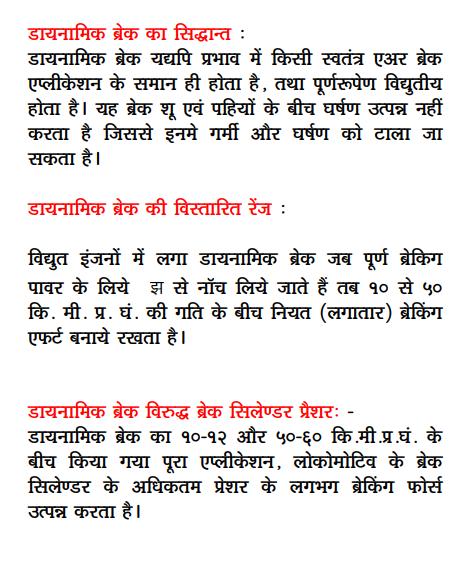
The dynamic brake, although similar in effect to an independent air brake application, is fully electrical and does not produce friction between the brake shoes and wheels, thereby avoiding heat and wear on these components.
Extended range Dynamic Brake
The extended range dynamic brake fitted to the electric locomotives maintains constant braking effort between 10 to 50 km/h while MP is set for full braking power.
Dynamic brake versus Brake cylinder pressure
A full application of the dynamic brake at speeds between 10-12 and 50-60 produces approximately the same braking force as maximum pressure in the brake cylinders on the locomotive.


AC Simulator - TRAIN HANDLING ON DESCENDING (DOWN) GRADE (डाउन (डिसेंडिंग) ग्रेडियेंट का संचालन )
TRAIN HANDLING ON DESCENDING (DOWN) GRADE
Starting of train in descending grade
Assuming train brakes & loco brakes are applied
i) Release loco brakes first then release train brakes.
iii) Pickup & maintain the maximum speed.
Negotiating descending grade
i) Start reducing notches after passing 1/4 th of entire train in the down gradient.
ii) Notches should be '0'up to 80% of train's maximum speed.
iii) Use dynamic brakes to avoid over speeding. Train brakes can also be used if required. Zonal Railway Training Institute, Central Railway, Bhusawal ©AC Loco Simulator.
iv) Before ending the down gradient train should be in released condition & there should be margin in speed to take few notches.
v) Advance MP only up to Ammeter reading starts increasing to avoid high buff force.
vi) Advance MP further to maintain maximum speed.
Stopping of train in descending grade
Reduce the speed by using Train / dynamic brakes.
i) Release dynamic brakes when speed comes to below 5 KMPH.
ii) Train brakes should not be completely released to avoid roll down of train.
iii) Apply Loco Brakes.
iv) Release train brakes only after proper protection of train.

AC Simulator - TRAIN HANDLING ON AN ASCENDING (UP) GRADE (अप असेंडिंग ग्रेडीयेट पर गाड़ी का संचालन )
TRAIN HANDLING ON AN ASCENDING (UP) GRADE
Starting procedure in ascending grade Assuming train brakes are applied
i) Move MP to take 3 or 4 notches (Keep watch on Ammeter)
ii) Release SA-9 (loco brake)
iv) Wait for few seconds until the Ammeter reading stops increasing and begin to reduce.
v) Advance WMP, wait for few second as
iv) for achieving maximum speed. Zonal Railway Training Institute, Central Railway, Bhusawal ©AC Loco Simulator.
Negotiating ascending grade
i) Before arriving up gradient, take sufficient momentum of train.
ii) Take maximum notches as you can up to the crest (end point of up gradient)
iii) Reduce notches after 3/4 of the entire train comes on level track.
iv) Maintain maximum speed.
Stopping of train in ascending grade
i) At a sufficient distance in advance of point of stopping, ease the MP notch by notch to allow speed to reduce naturally due to the grade.
ii) Stop the train with the help of A9 (train brake).(to avoid roll back of train)
iii) Apply SA-9 (loco brake)
iv) Before releasing train brakes train should be protected.


AC Simulator - TRAIN HANDLING ON A LEVEL SECTION (लेवल सेक्शन में गाड़ी का संचालन )
TRAIN HANDLING PROCEDURES IN DIFFERENT GRADIENTS
(Starting, Negotiating & Stopping of train)
TRAIN HANDLING ON A LEVEL SECTION
Starting of train from level section
i) Keep train brakes in released condition.
ii) Move MP to take 1 notch and simultaneously release SA-9.
iii) Wait for few seconds until the Ammeter reading stops increasing and begin to reduce.
v) If necessary, advance the MP to 3 or 4 notches but always wait for a few second {as in (iii)} between each notch position.
vi) When the train is in a stretched condition and in motion, slowly advance the MP as required {as in (iii)} for achieving maximum speed of the train.
Negotiating level section
i) After achieving maximum speed, maintain it by increasing / decreasing notch. Zonal Railway Training Institute, Central Railway, Bhusawal ©AC Loco Simulator. 70
ii) Avoid frequent changing in notches as this develop slack in the train.
Slowing of train in level section
i) At a sufficient distance in advance of point of slowing, ease the MP notch by notch for the slack to adjust to a bunched condition.
ii) Coasting to be done for some distance before braking.
iii) Apply Dynamic / train or both brakes as required.
iv) Observe speed restriction. (In low speed caution order try to negotiate caution order in release condition.)
v) Release Train / Dynamic brakes as the termination indicator is approached.
vi) After complete release of train advance MP for achieving maximum speed.
Stopping of train in level section
i) Same procedure of slowing of train from i) to iii)
ii) When the speed has reduced sufficiently so that dynamic brake effect fades (below 5 KMPH), release A9 (train brakes) and Zonal Railway Training Institute, Central Railway, Bhusawal ©AC Loco Simulator. 71 gradually release the dynamic brake at the same time.
iii) As the train comes to stop apply SA-9(loco brakes).


AC Simulator - Engineman ship (इंजिमनशिप )
Engineman ship
It is the capability of a Loco Pilots to handle his loco along with its trailing load, so that it reaches destination in time in a most economic manner and without adversely affecting safety. Poor engineman ship adversely affects all these requirements. Same is also a contributory factor leading at times to train parting, and on other occasions result in stalling, passing signal at danger, brake binding, loco failure or even derailment. Such of these factors, which are associated with Loco Pilots enginemen ship.
How the tractive effort exceeds the tensile strength ?
1. Due to sudden notching up.
2. Sudden application of brakes from rear.


AC Simulator - TRAIN PARTING ( ट्रेन विभाजन )
TRAIN PARTING
Train parting is a common unusual occurrence affecting the train movement. There are number of contributing factors towards train parting such as poor driving technique, inadequate maintenance, material failure, improper marshalling, loco troubles, etc.
When The Train Parting Takes Place?
3. If any coupling gets dis-engaged due to excessive buffer height/ difference in rail level.
Zonal Railway Training Institute, Central Railway, Bhusawal ©AC Loco Simulator. 67 Out of the above 3 situation the first one is related to wrong driving technique adopted by loco pilots, provided there is no material failure.


AC Simulator - COUPLER POSITIONS (कपलर स्थितियां )
COUPLER POSITIONS
COUPLER EXTENSION:
Movement of two couplers in opposite outer direction is called coupler extension. ( This happens during run out)
COUPLER COMPRESSION
Movement of two couplers in opposite inner direction is called coupler compression. (This happens during run in)

COUPLER FORCES
DRAFT FORCE :
Force required for pulling other attached coupler / wagon is called draft force. Pulling of the other wagon starts only after complete extension of the couplers attached together.
BUFF FORCE : Force required for pushing other attached coupler / wagon is called buff force. Pushing of the other wagon starts only after complete compression of couplers attached together


AC Simulator - परिभाषाए
DEFINITION
DRAWGEAR
The actual coupling between locomotive and wagon, and wagon to wagon.
DRAFTGEAR : The impact absorbing apparatus whereby the drawgear is attached to the locomotive or wagon.
TRAIN AS ELASTIC MASS:
There are two kinds of slacks:
1. Free Slack : Free slack is the clearance with in the drawgear which can run-in or run-out without compressing the draftgear. Free slack can be as high as one inch between two couplings of the vehicle.
2. Spring Slack : Spring slack is the additional amount of movement that can occur after the free slack movement is finished and when draftgear is compressed and which then rebounds and drives all slack in opposite direction. Spring slack for conventional draft gear can amount to approximately 5 inches per vehicle when fully compressed.

Therefore there is a sizeable potential movement within a train between the front and rear as illustrated below:

It is very much essential to control the run-in / runout slack movements because the destructive force or shock increases with square of the speed. When a wagon at a speed of 5 KMPH hits or draws a wagon running at 3 KMPH (speed difference 2 Free Slack Spring Slack. KMPH) creates a shock 4 times that of 1 KMPH speed difference. Similarly,
at 3 KMPH speed difference impact will be 9 times that of 1 KMPH. at 4 KMPH speed difference impact will be 16 times that of 1 KMPH.
RUN-IN: When a rear section of a train is travelling faster than a forward section of a train. Run-in may be a combination of slack movement and spring slack dependent upon the forces generated.
RUN-OUT: When a rear section of a train is travelling slower than a forward section of a train. Run-out may also be a combination of slack movement and spring slack dependent upon the forces generated.
BREAK-IN-TWO / COUPLER BRAKAGES : The life of a coupler depends on how much less fatigue it has gained. The more the fatigue the less will be the remaining life of the coupler. The coupler fatigue depends on how many times it has undergone stress & strain during the train travel. The frequent run-in & run-out of wagons (coupler compressions & extensions) with heavy slack speeds increases the coupler fatigue. Thus it is evident that controlled run-in / run-out / slack movement can reduce coupler fatigue. The less number of times run-in to run-out and run-out to run-in occurs the less will be the shock on the couplers & coupler fatigue.
ADHESION: That grip which the wheels have on the rail dependent upon weight, track condition and weather conditions.
ENERGY CONSUMPTION: Consumption of electricity by a locomotive for moving train from one location to another location. Unit of electric energy is Kwh.
TONNE KM/KWH: Load hauled by a loco for a length of one Kilometer on consumption of one unit of electricity.
JERK: It can be felt when sudden changes on coupler force takes place either from Draft force to Buff force or Buff force to Draft force.
LURCH: It can be feel when sudden changes in track gradient from level to down & then up (due to track defect).


AC Simulator - Comparison between driving a road vehicle & train (आम वाहन तथा रेल गाड़ी में अंतर )
COMPARISON BETWEEN DRIVING A ROAD VEHICLE AND TRAIN
Just as we expect from a road vehicle driver that he should drive his vehicle smoothly and safely, so is the expectation of public at large from the train driver. The similarity however, ends here, as there is a marked difference in the Zonal Railway Training Institute, Central Railway, Bhusawal functioning and appreciation involved in train working. Some of the major areas are as below: -
1. The road vehicle by virtue of its size is fully under the control of the driver who has to focus his driving skills over a short distance, and is fully in control of the vehicle with regard to speeding or slowing down, or even bring it to a sudden halt. On the other hand, with the trailing load running into thousands of tones along with the locomotive forms one unit, which the driver has to control. To compound the problem, the entire mass (or vehicle as it can be termed in comparison to the road unit) is elastic associated with linked dynamics.
2. While for the road driver it is not a pre-requisite to know the route on which he has to travel, the train driver is required to be fully familiar of not only the section on which the train is to be worked but even the sectional geographical condition.
3. Increasing of the speed of the vehicle involve change of gears which train driver increased or decreases the speed by use of the notches.
4. The road vehicle driver controls the speed of the vehicle according to the traffic and route Zonal Railway Training Institute, Central Railway, Bhusawal and can reduce/increase speed with gear change, and can simultaneously apply the brakes. On the other hand, the train driver has to control the speed of the entire trailing mass with the notches, and before applying the brakes; it is required to bring to zero notch position.
5. Road vehicle driver can turn his vehicle by the help of the steering wheel. On the other hand, train driver has no such flexibility for bypassing obstacles, impediments or abnormalities that is seen enroute.
6. While the braking distance of a road vehicle is small and easily controllable, that of a train is long and requires considerable skill to bring the train to a stop in case of an obstacle especially in emergency.
7. While there is no restriction of speed on road vehicle driver, for train the margin within which the same is to be run varies and requires continuous attention of the driver. Dropping the speed below the minimum stipulated means loss of time and exceeding the maximum speed spells danger.
8. Failure of a road vehicle enroute has no accident related implications. Generally, it can Zonal Railway Training Institute, Central Railway, Bhusawal be easily shifted on the sideline without blocking the traffic movement. On the other hand, stalling of a train has serious ramification, as not only it blocks the section, but immediate communication is required to be made to adjoining station, control and various other operational units for regulating the traffic and taking steps for moving the train with alternate arrangement.
9. While the application of brakes in a road vehicle is a simple procedure, it is highly complicated in train vehicle which involves technical know-how, skill and control due to elastic nature of the train mass.
10. Endanger of safety of human loss during the road vehicle failure/break down is negligible. On the other hand, failure timely steps of a stalled train carrying passengers can lead to a major accident, specially in case of a passenger train.
To sum it up, the road vehicle driver does not require any technical training as long as he has basic driving skills developed over a period of time, on the other hand for the train driver, every train is a new experience, requires more sound driving technique as the trailing load varies from Zonal Railway Training Institute, Central Railway, Bhusawal passenger train to freight train running into thousands of tones of trailing load.


ADVANTAGE OF SIMULATOR TRAINIG ( सिमुलेटर प्रशिक्षण के फायदे )
ADVANTAGE OF SIMULATOR TRAINIG :
- To reduce energy consumption.
- For reducing Brake wear.
- To improve overall performance & confidence of Loco Pilots.
- To minimise coupler damages.
- To minimise stalling cases.
- To reduce in-train coupler forces resulting in train parting or break in two and derailment.
- To maximise safety, punctuality, comfort to passengers, and minimise damage to man, material and money. For improvement in reliability.
- To increase the confidence of Loco Pilots in their own ability.
- To reduce on line training time. To ensure consistency in training.

AC Simulator - Training Methodology Adopted In Simulator
TRAINING METHODOLOGY ADOPTED IN SIMULATOR
The object of Indian Railway as transport organisation is to move people & goods safely, on time and at the total lowest cost. To fulfill this object, Loco Pilots are encouraged to think of Simulator facility as a 'temple' where people gather and discuss train-driving technique in an environment, which encourages sharing of experiences, and also to adopt the best practices for achieving maximum efficiency. The methodology adopted in this centre is the patented Strategy Based Learning System ( SBL ® ) which was handed over along with the simulator by the AusAid. It differs vastly from the traditional training methods. In SBL ® every participant learns by way of self realization and discussion with cotrainees and Instructors and the Instructors are very friendly with the trainees where as in traditional training methods knowledge is pumped to the trainees without creating an interest in trainees to accept the knowledge.
The trainees are given opportunity to review their driving reports independently. The layout of the classroom is in such a manner where Instructor can have close interaction with the trainees and the participants are feeling more comfortable to ask questions and to participate in the discussion in very close manner.
AC Simulator - WHY SIMULATOR TRAINING IS REQUIRED ? ( सिमुलर प्रशिक्षण क्यों आवश्यक है )
WHY SIMULATOR TRAINING IS REQUIRED ?
Driving of train looks so easy; the singleman does all the steering, and is to stop when required. However, accidents prove that driving a train is not quite so simple as it looks. The driver must continuously watch out and obey every signal, without fail. He must always be on the alert and must never loose his concentration for an instant.
The method to be used in dirving a train depends upon many factors such as, the type of locomotive being used; load and length of the train and amount of slack in the train; the weather, topography and track condition. Since all these factors are variable, so finally the operator whose good judgment in applying his skill that leads to smooth and accident free train running.

Train Driving Techniques - AC Simulator - सिमुलेटर क्या है ?


Simulator is a replica of a machine, based on computer technology. Train Driving Simulator consists of a real time loco driving cab, which facilitate the trainees to drive a train, which gives us real feeling of on line train working.
AC locomotive Simulator is a mathematical model of a train over a railway track with associated synchronized audio sound and recorded vision.
Subscribe to:
Posts (Atom)
